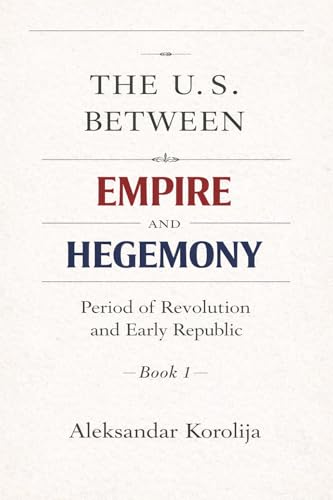
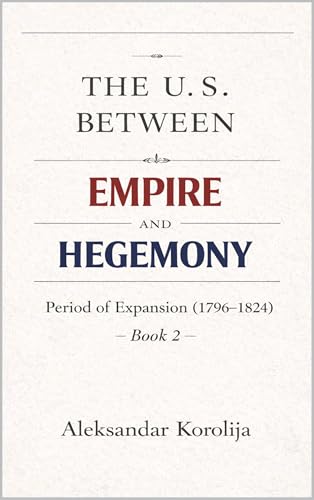
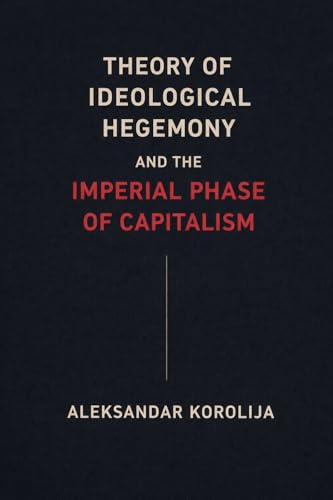
The U.S. Between Empire and Hegemony
Period of Revolution and Early Republic
A historical-sociological account of how class alliances, economic transformation, and federal institutions laid the foundations of American hegemony.
Assistant Professor · Research Associate
Research on hegemony, imperialism, and the historical formation of American power. Books, peer-reviewed articles, essays, and videos in one place.
Three books tracing ideology, imperial power, and the formation of U.S. hegemony.
Period of Revolution and Early Republic
A historical-sociological account of how class alliances, economic transformation, and federal institutions laid the foundations of American hegemony.
The Period of Expansion (1796–1824)
The second volume follows territorial expansion, economic change, and crises of political leadership from the fall of the Federalists to the fragmentation of the Republican bloc.
Ideology, institutions, and the world system
A theoretical synthesis of Marx, Gramsci, and Althusser, developing the concept of imperial ideological apparatuses.
Browse the eight papers currently listed on my Academia.edu profile. Each entry links to the journal or paper page.
A study of how merchants, landowners, artisans, and yeomen formed a revolutionary alliance through conflict and institutional change.
Read articleUses Marcuse and class analysis to examine the limits of colonial boycotts as a challenge to consumer society.
Read articleExamines lithium extraction in Chile, Argentina, and Bolivia, including conflicts involving global capital, governments, and local communities.
Read articleConnects higher education and migration of skilled workers to unequal relations between core and peripheral countries.
Read articleA Gramscian analysis of the structural limits and transformative strategies of new social movements.
Read articleExplores how Subaltern Studies applies Gramsci’s ideas to Indian history, peasant politics, and nationalist movements.
Read articleRevisits the concept of imperialism through Marxist and world-systems theory in a changing geopolitical setting.
Read articleExamines Gramsci’s distinction between civil and political society and its implications for hegemony, domination, and the state.
Read articleScroll through individual essays on theory, the American Revolution, the early republic, and U.S. expansion. Open any piece on Substack to read it in full.
Introduces a Gramscian framework for analyzing the formation of American hegemony.
Read essayQuestions familiar claims about equality in colonial America by examining its social structure.
Read essayConsiders colonial manufacturing as a material foundation of revolutionary politics.
Read essayExamines boycotts through the interests of different colonial classes and the ideology of resistance.
Read essayLooks at colonial assemblies as institutions shaping political leadership before independence.
Read essayExplores the Continental Congress as a center of coordination and leadership during the Revolution.
Read essayTraces competing positions within the revolutionary alliance at the moment of independence.
Read essayConsiders the army’s role in holding together and advancing the revolutionary project.
Read essayAn accessible account of how colonial class alliances developed and became organized during the revolutionary crisis.
Read essayFollows the early federal debate over military power, militias, internal rebellion, and frontier conflict.
Read essayExamines federal finance and the political role of the First Bank in the early republic.
Read essayExplores the tensions between commercial interests and neutrality in early U.S. foreign policy.
Read essayDiscusses the momentum of U.S. territorial expansion in the early nineteenth century.
Read essayExamines emerging imperial tendencies in the expansion of American power.
Read essayUses Aesop and Gramsci to reflect on the workings of ideological hegemony.
Read essay
Aleksandar Korolija is an assistant professor and research associate in sociology. His work connects political theory, historical sociology, and political economy. He examines how hegemony is formed and maintained through class alliances, institutions, ideology, and the unequal relations of the world system.
His books on the early United States investigate the relation between territorial expansion and political leadership. His theoretical work studies the institutions through which power is reproduced beyond the nation-state.